
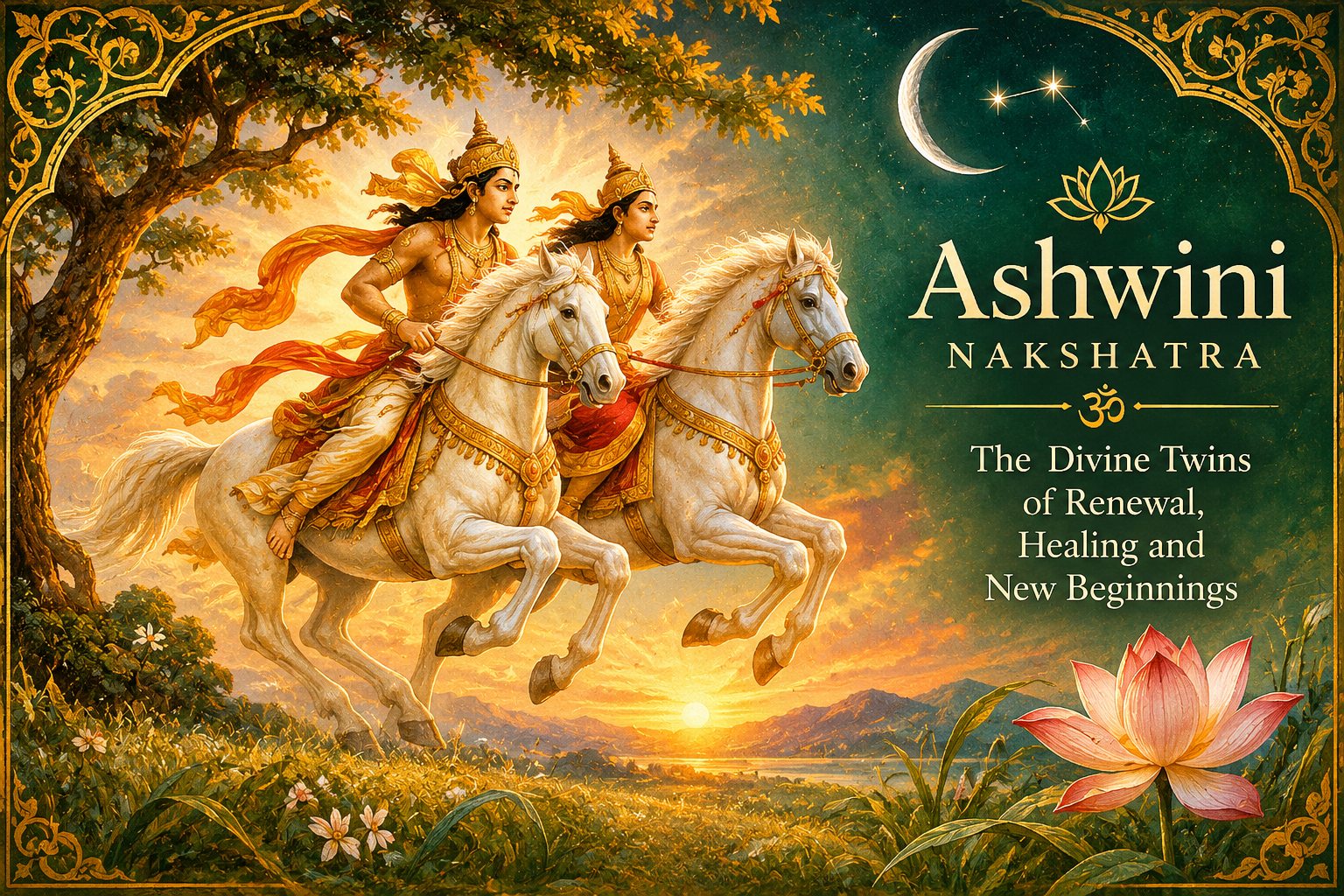
Naksatras — 01 of 27
Aśvinī Nakṣatraअश्विनी
Speed That Arrives When It Is Needed
Asvini is the first of the twenty-seven naksatras, and it is easy to read it as a simple instruction: begin, and begin fast. The Vedic sources that stand behind it suggest something more exact.
At a Glance: Asvini Naksatra
Where the Cycle Begins
The naksatra sequence opens at Asvini and closes at Revati. That placement matters in Jyotisa. A beginning in this tradition is not a blank slate; it comes at the end of something, and the first degrees of Asvini sit directly beside the last degrees of Revati, at the junction known as gandanta. Whatever begins here begins with the previous cycle still close behind it.
Ketu as lord adds a distinctive note. Ketu is the planet of detachment, of what has already been worked through, of the thread that does not hold on. A naksatra of initiative governed by the planet of release suggests a beginning that does not depend on the past for its energy, and does not cling to its own outcomes either. Mars, as lord of Mesa, supplies the drive. Ketu offers a quality that is less obvious: the ability to start without needing the start to prove anything.
What the Rgveda Actually Says About the Asvins
The primary sources for the Asvins are the hymns of the first mandala, especially Rgveda 1.116 to 1.120, attributed to the rsi Kaksivan Dairghatamasa. Read together, they are less a portrait of a deity than a catalogue of interventions. The Asvins are praised for what they did, one named person at a time.
Rescue as the defining act
- Bhujyu is carried out of the ocean, in some verses by winged vessels or horses (1.116.3 to 1.116.5; 1.117.14) and in others by a ship with a hundred oars (1.116.5).
- Atri is brought up out of the pit or cavern where fire threatens him, with the fire cooled (1.116.8; 1.117.3).
- Vandana is lifted from the pit like buried treasure (1.116.11; 1.117.5), and Rebha is raised from the waters (1.116.24; 1.117.4).
- The hymns do not praise the Asvins for general strength. They praise them for arriving at a precise moment of need, with a precise remedy.
Restoration of the body
- Cyavana is made young again (1.116.10; 1.117.13).
- Vispala receives an iron leg (1.116.15; 1.117.7). Sayana and Griffith read this as a woman fighting in battle; Geldner read it as a race, so the setting is a matter of translation.
- Rjrasva's sight is restored (1.116.16).
- Dadhyanc, the sage, speaks through a horse's head and makes known the madhu (honey, sweetness) to the Asvins (1.116.12; also 1.119.9), so that healing and sacred knowledge are connected from the start. Griffith renders madhu in 1.116.12 as the sweetness of Soma.
The consistent pattern is repair that returns a person to their own life. Nothing in these episodes suggests the Asvins take over the person's path. They restore capacity and step back.
Dawn and the threshold
The Asvins are dawn-twins, coming before the sun in the liminal hour between night and day. In 1.116.17 the daughter of the Sun ascends their chariot, which ties them to the sun's domain. This is the strongest textual support for Asvini as a naksatra of beginnings: their domain is the threshold itself.
The Asvins and Pusan: Two Kinds of Guardianship
Pusan does not appear in the Asvin hymns, but he belongs in this conversation because he is the deity of Revati, the naksatra that stands directly before Asvini. His material lives elsewhere in the Rgveda, notably 1.42, 6.53 to 6.58 and 10.26. At the funeral hymn 10.17.3 he is asked to convey the dead to the Pitrs.
- The Asvins repair and revive. They arrive in the emergency.
- Pusan guides and retrieves. He is protector of roads and travellers, and the one who finds what has been lost.
Both are associated with movement and safe passage, and both appear at moments of crossing. Both appear at the marriage of Surya: she ascends the Asvins' chariot in 1.116.17, and Pusan is asked to lead the bride by the hand in 10.85.26. Taken together, Revati and Asvini form a pair at the turning of the cycle: one oversees the journey and its safe completion, the other meets the new beginning with energy and repair. This pairing is an interpretive frame used in Jyotisa. The hymns themselves do not state it, and it should be held as interpretation rather than scripture.
The Shakti of Asvini: Speed With an Aim
Classical Jyotisa describes Asvini as a ksipra (swift) naksatra, and its traditional power is the capacity to reach quickly. That description is accurate, and it is often read as a license for haste. The hymns correct this reading. The Asvins are fast, but their speed is always attached to a particular rescue. A chariot that arrives swiftly at the wrong place does no one any good.
This suggests a more demanding way to read the naksatra. The quality of Asvini is not simply that things start quickly. It is the capacity to move when the moment calls for movement, toward the thing that actually needs attention.
A Contemplative Reading
Used contemplatively rather than predictively, Aśvinī raises a practical question: what is this beginning actually responding to?
Modern research on behaviour change offers a useful parallel without needing to prove anything about the naksatra. In a widely cited meta-analysis, Gollwitzer and Sheeran (2006) found that forming specific if-then plans, called implementation intentions, had a medium-to-large effect on goal attainment across 94 independent studies. The finding is not about enthusiasm or speed. It is about specificity: a start tied to a particular cue and a particular response. This is close in spirit to the Asvin hymns, where the intervention is defined by the exact need it meets.
A second finding keeps the picture honest. Lally and colleagues (2010) studied how long it took people to make a new behaviour automatic and found a wide range, with an average of 66 days and individual cases from 18 to 254 days. A fast beginning is not a completed transformation. This is why the sequence does not end at Asvini; the next naksatra, Bharani, exists to carry what Asvini starts.
- Where am I moving quickly because something genuinely calls for it, and where because stillness is uncomfortable?
- If I looked closely at the start I am about to make, what specific need is it meeting?
In Consultation
When Asvini is prominent in a chart, through the Moon, the lagna, or a significant planet, the tradition points to initiative, vitality and a capacity for restoration. In practice, the more useful conversation is about direction. Speed is the visible quality; discernment about where to apply it is the work. The Asvins offer a model for this: restore the capacity, meet the real need, and leave the person in charge of their own path.
During a Ketu dasa or antardasa, the Asvini themes of release and fresh starts may take a particular shape, often connected to letting an older pattern end without forcing a replacement in its place. As always, this is an invitation to reflect, not a forecast.
Frequently Asked Questions
Which planet rules Asvini Naksatra?
In the Vimshottari dasa system Asvini is ruled by Ketu. The naksatra sits entirely within Mesa (Aries), from 0°00′ to 13°20′, so Mars as lord of the sign also colours how it expresses.
Who are the Asvins?
The Asvins, or Asvini Kumaras, are the divine twin physicians of the Rgveda. They are dawn-deities who arrive at moments of crisis to rescue, heal and restore, and they are the presiding deities of Asvini Naksatra.
What is Asvini Naksatra's symbol?
The traditional symbol is a horse's head, pointing to speed, vitality and the capacity to cover ground quickly.
Does a strong Asvini placement mean someone acts impulsively?
Not necessarily. The tradition links Asvini with swiftness, but the Asvin hymns describe speed aimed at a specific need. Read contemplatively, the question is not how fast someone moves but whether the movement meets what is actually required.
How is Asvini connected to Revati?
Revati is the last naksatra and Asvini the first, so they meet at the junction between Mina and Mesa, known as gandanta. Revati is associated with Pusan, guardian of paths, and Asvini with the Asvins, who intervene at crisis points. The pairing is an interpretive framing within Jyotisa rather than something the Vedic hymns state.
Continue the Series
Aśvinī begins the sequence. The next article in the series will explore Bharaṇī Nakṣatra — what carries a beginning through to completion. For the wider planetary context, see the Meeting the Grahas series.
Sources
- Rgveda 1.116 to 1.120 (Asvin hymns, attributed to Kaksivan Dairghatamasa); Pusan hymns at 1.42, 6.53 to 6.58, 10.26; funeral hymn 10.17.3; wedding hymn 10.85.26. Verse numbers follow Griffith (1896), The Hymns of the Rigveda.
- Gollwitzer, P. M., & Sheeran, P. (2006). Implementation intentions and goal achievement: A meta-analysis of effects and processes. Advances in Experimental Social Psychology, 38, 69 to 119.
- Lally, P., van Jaarsveld, C. H. M., Potts, H. W. W., & Wardle, J. (2010). How are habits formed: Modelling habit formation in the real world. European Journal of Social Psychology, 40(6), 998 to 1009.
About the Author
Elle J. Feurtado Elle J. Feurtado is a Jyotisa Pandita, a traditionally trained Vedic astrologer based in the UK, and the founder of Vedic Astrology 369. Her work spans consultations, education and a content library rooted in classical Jyotisa, Vedic philosophy and related sister sciences.
Understand Your Own Chart
The Nakshatras reveal dimensions of character and timing that the rasis alone cannot show. A personal consultation with Elle J. brings your own Nakshatra placements into focus.
Book a Consultation