
The Four Attitudes and the Wasp: What Maitrī Requires of Us Beyond the Human
Yoga Sūtra 1.33 names four attitudes that clear the mind. What does maitrī — friendliness — ask of us when the one in front of us is a wasp?
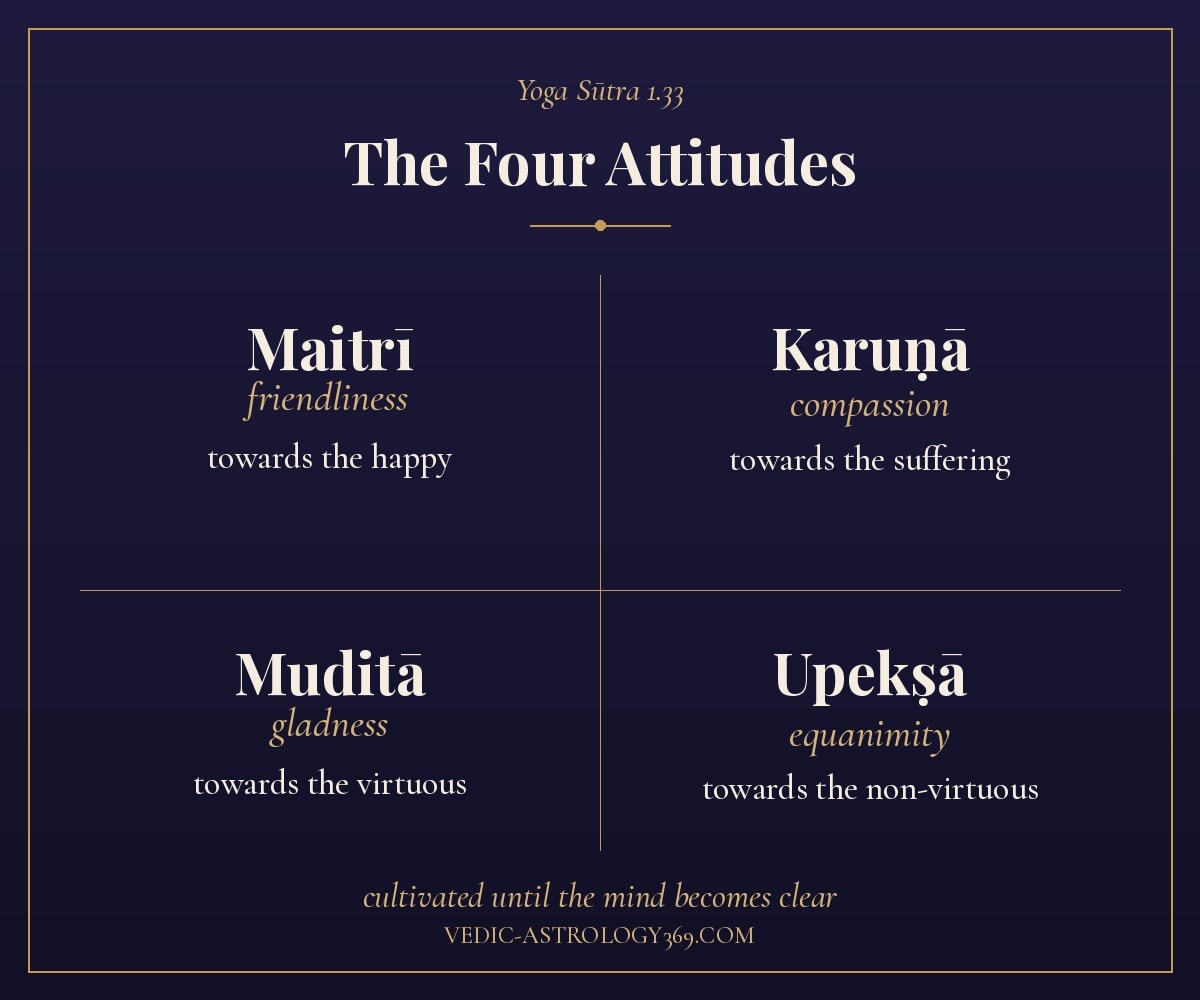
Yoga Sūtra 1.33 names four attitudes — maitrī (friendliness), karuṇā (compassion), muditā (gladness) and upekṣā (equanimity) — and says that cultivating them makes the mind clear. The tradition never limits them to humans. A wasp in the kitchen is simply the place where most of us feel the circle close.
A wasp has come into the kitchen. You know what happens next: the flinch, the tightening in the shoulders, the quick calculation of what is within reach. Before any thought about kindness or philosophy, the body has already decided what the wasp is.
That moment is a better test of a teaching than most retreats. It shows what a practice has actually changed, rather than what a person believes about themselves while sitting comfortably. This article takes one of the best-known passages in yoga, the four attitudes of Yoga Sūtra 1.33, and asks what it requires of us when the creature in front of us is not a friend, not a person, and not remotely interested in our spiritual development.
The four attitudes, and what they are for
Patañjali's sūtra is short. Through cultivating friendliness (*maitrī*) towards the happy, compassion (*karuṇā*) towards the suffering, gladness (*muditā*) towards the virtuous, and equanimity (*upekṣā*) towards the non-virtuous, the mind becomes clear (*citta-prasādanam*).
Two details are easy to miss. The first is that the attitudes are matched to situations. Each one answers a particular kind of encounter: another's happiness, another's pain, another's goodness, another's failings. Most of us have one default response for all of them, usually either warmth or judgement. The second is that the stated purpose is not to become a nicer person. It is clarity of mind. Our relationships are the training ground, and the settled mind is the result. The verb matters too. *Bhāvanā* means cultivation, something grown deliberately over time rather than a feeling that either turns up or doesn't.
Does the sūtra reach a wasp?
The sūtra's examples are about people: the happy, the suffering, the virtuous. It is fair to ask whether the practice stops there. The wider tradition says it doesn't. The Gītā describes the person dear to Krishna as *adveṣṭā sarva-bhūtānāṁ maitraḥ karuṇa eva ca*: one who hates no being, and is friendly and compassionate (12.13). *Sarva-bhūtānām* means "of all beings", and nothing in the phrase is limited to our own species. Elsewhere the Gītā praises the wise as those of equal vision (*sama-darśinaḥ*), who see the same presence in a learned person, a cow, an elephant and a dog (5.18). And Yoga Sūtra 2.35 says that when ahiṃsā, non-harming, is firmly established, hostility is abandoned in its presence.
So the circle was never meant to close at the edge of the human. The wasp is simply the place where most of us feel it close.
What the wasp asks of each attitude
What follows is a contemplative reading of the sūtra, not a classical commentary. Take the four attitudes in turn, with the wasp in mind.
*Maitrī* asks whether friendliness is possible before judgement arrives. A wasp on a flower in the sun is simply content in the way wasps are. Can that be allowed to stand without an edge of threat?
*Karuṇā* appears when the same wasp is battering itself against the window, frantic, trapped, unable to find the open half of the pane. Compassion doesn't require liking the wasp. It only requires noticing that something is in distress.
*Muditā*, gladness at what is done well, is the hardest to apply. Many wasps hunt the insects that strip our gardens, and some are pollinators. A fig cannot be pollinated without its own tiny wasp. Gladness here means seeing that this being has a place in the working of the world that has nothing to do with us.
*Upekṣā*, equanimity, belongs to what we judge as harmful: the sting, the wasp on the sandwich. It doesn't mean indifference. It means staying steady without letting the judgement harden into hatred.
What maitrī does not ask
None of this requires you to let yourself be stung. If a sting is dangerous for you, protecting yourself is not a failure of maitrī. A glass and a piece of card, or an open window, are a perfectly good expression of the four attitudes: firm, practical and free of contempt. The difference lies in what is happening inside while the hand moves. Hatred and equanimity can carry out the very same action, and the mind that comes out the other side is not the same mind.
Nor does maitrī require you to feel something on demand. Because the tradition's word is cultivation, it asks for a direction of attention that is practised until it becomes the default, not for a warm feeling produced on the spot.
What research on loving-kindness and animals found
A qualitative study in *Sustainability Science* (Asplund and Dobrin, 2026) looked at the journals of thirty people who practised loving-kindness meditation towards animals during a ten-week course. The pattern will be familiar to anyone who has ever flinched at a wasp. Participants found it easy to extend kindness to pets and to animals they thought beautiful. Animals that disturbed them, disgusted them or frightened them tended to fall outside the circle. One participant named wasps among the creatures she found fearful. Another noticed that kindness came more readily towards pollinators, and observed that it is easier to feel it for cute animals than for disgusting ones, even when you know the latter serve an ecological purpose.
The authors read this as a sign that the practice is not about feeling warm towards what is already easy to love. Its work lies in loosening the habit of conditioning care on liking or disliking, so that kindness no longer depends on whether a creature is beautiful or useful. Buddhist teaching has a name for the trap: affection and sentimentality are the "near enemies" of loving-kindness, because they resemble it. The study is small and qualitative, drawn mostly from middle-aged and older women on a single course, and the authors say plainly that the evidence is too limited for firm conclusions about whether the practice reduces prejudice towards disliked species. What it offers is a clear picture of where the practice meets resistance, and that is exactly where the wasp comes in.
A Jyotiṣa perspective
In Jyotiṣa the Moon rules the mind (*manas*), and the condition of the Moon in a chart describes how readily that mind settles, what unsettles it, and what it needs in order to quiet. Patañjali's word for the settled mind, *citta-prasādanam*, comes from a sister discipline and describes a closely related idea. Read together, the four attitudes are not a moral accessory to astrology. They are among the oldest practical tools for doing what a Jyotiṣa reading is ultimately in service of: helping a person understand their own mind clearly enough to live from it with greater freedom.
The Moon's placement in a chart often shows where the circle of care naturally extends and where it contracts. A strongly placed Moon in a sign of broad vision may find the four attitudes come relatively easily. A Moon under pressure may find that the circle closes quickly, and that the wasp — or its human equivalent — triggers a reaction that feels beyond choice. That is not a moral failing. It is information about where the practice is most needed.
A practice for the week
The next time something small and unwelcome unsettles you (a wasp, a spider, a pigeon on the sill), allow four breaths before you act. On the first, look for what in the creature is simply content. On the second, notice any distress. On the third, find one thing it does well. On the fourth, release the verdict. Then do whatever the situation actually requires.
A clear mind is not built only in long silences. It is also built in the thirty seconds after a wasp comes in.
You can find more reflections like this in [the Library](https://vedic-astrology369.com/library), or [book a consultation](https://vedic-astrology369.com/contact-us) if you'd like your own chart read with this kind of attention.
Frequently Asked Questions
What are the four attitudes in the Yoga Sūtras?
Yoga Sūtra 1.33 names four attitudes to cultivate towards different situations in life: maitrī (friendliness) towards those who are happy, karuṇā (compassion) towards those who suffer, muditā (gladness) towards the virtuous, and upekṣā (equanimity) towards what is non-virtuous. The sūtra says that cultivating them makes the mind clear.
What does maitrī mean?
Maitrī means friendliness or goodwill: an attitude of wishing well that does not depend on liking, agreeing with, or being close to someone. In the Yoga Sūtras it is cultivated deliberately as a practice (bhāvanā), not waited for as a feeling.
Do the four attitudes apply to animals and insects?
Nothing in the tradition limits them to humans. The Bhagavad Gītā describes the ideal practitioner as friendly and compassionate towards all beings (sarva-bhūta, 12.13), and Yoga Sūtra 2.35 links established non-harming with the abandoning of hostility. Applying the four attitudes to a creature such as a wasp is a contemplative extension of these teachings, not a classical commentary on sūtra 1.33.
Is maitrī the same as loving-kindness?
They are closely related. Maitrī is the Sanskrit term, and mettā is its Pali counterpart, the first of the four brahmavihāras taught in the Buddhist tradition, which parallel the same four attitudes. The Yoga Sūtra frames the attitudes as a way of clearing the mind, while loving-kindness practice teaches them as boundless qualities directed towards all beings.
Ready to explore your own chart?
A personal consultation with Elle J. brings your chart to life — with clarity on timing, purpose, and the patterns that shape your path.